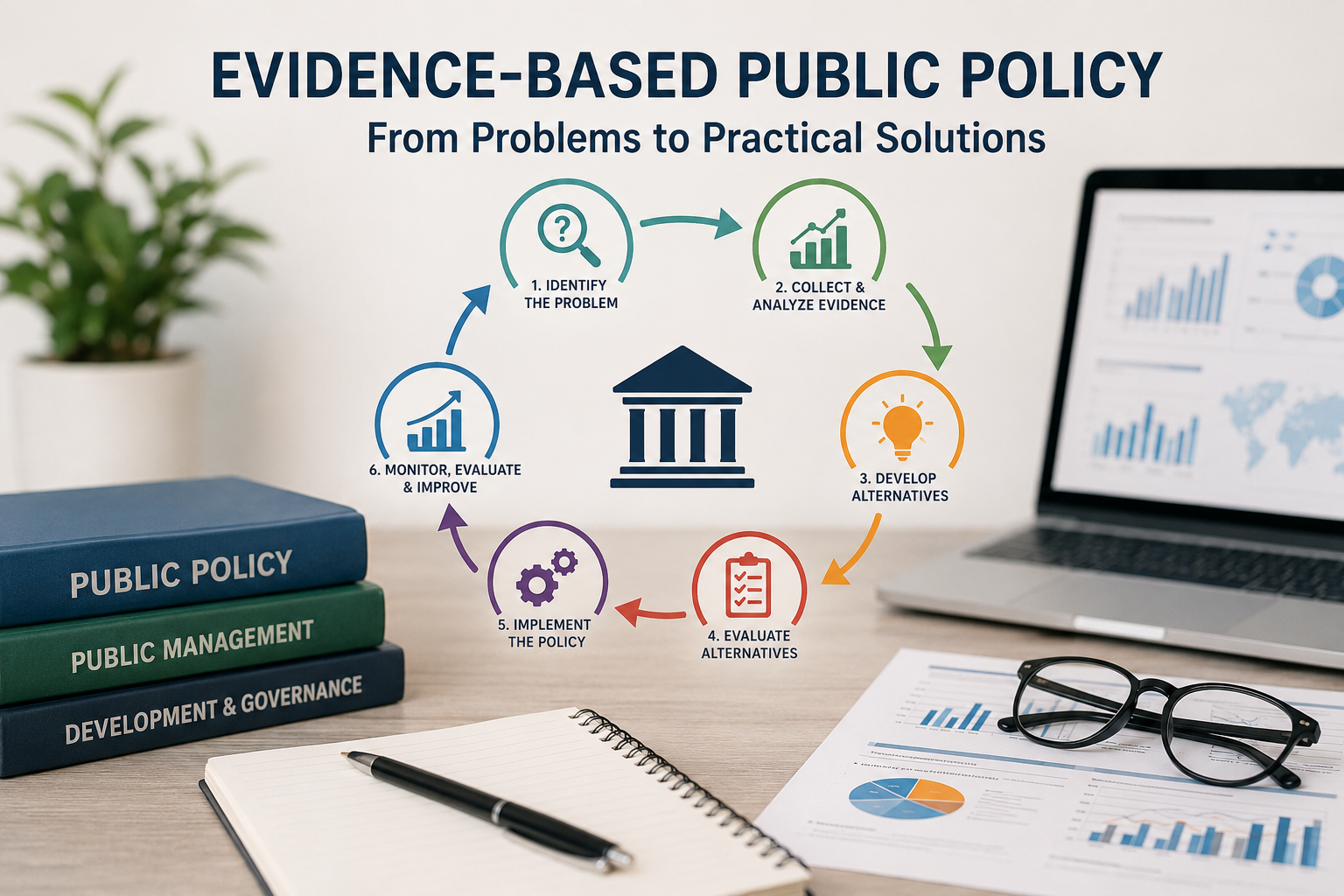
Evidence-Based Public Policy: From Problems to Practical Solutions
Introduction
Governments make decisions that affect almost every aspect of people’s lives—from education and healthcare to employment, economic development, security, and social protection. However, good intentions alone do not guarantee good public policy. Effective policies require careful analysis, reliable evidence, responsible management, and continuous evaluation.
Table of Contents
Public policy analysis
provides a systematic approach to understanding public problems, identifying possible solutions, and determining which interventions are most likely to produce meaningful results.
In developing countries, where public resources are often limited and social needs are significant, evidence-based policymaking becomes particularly important. Governments must make difficult choices about how to allocate limited financial, human, and institutional resources while attempting to achieve the greatest possible public benefit.
Evidence-based policymaking can help governments move away from decisions based primarily on assumptions, political pressure, or short-term considerations and toward decisions informed by reliable information and systematic analysis.
What Is Public Policy?
Public policy can be understood as a set of decisions, actions, strategies, and priorities adopted by governments to address problems affecting society.
Public policies can address a wide range of issues, including:
- Poverty and unemployment
- Access to education
- Healthcare services
- Women’s economic participation
- Infrastructure development
- Environmental protection
- Public-sector reform
- Social protection
- Economic growth
A successful policy should not simply identify a problem. It should provide a realistic pathway toward addressing that problem.
For example, if unemployment among young people is increasing, a government might consider vocational training, private-sector incentives, entrepreneurship programs, public employment schemes, or educational reform.
However, the important question is not simply “What should the government do?”
The more important question is:
Which policy intervention is most effective, affordable, feasible, equitable, and sustainable under existing conditions?
That is where policy analysis becomes essential.
From Public Problems to Policy Solutions
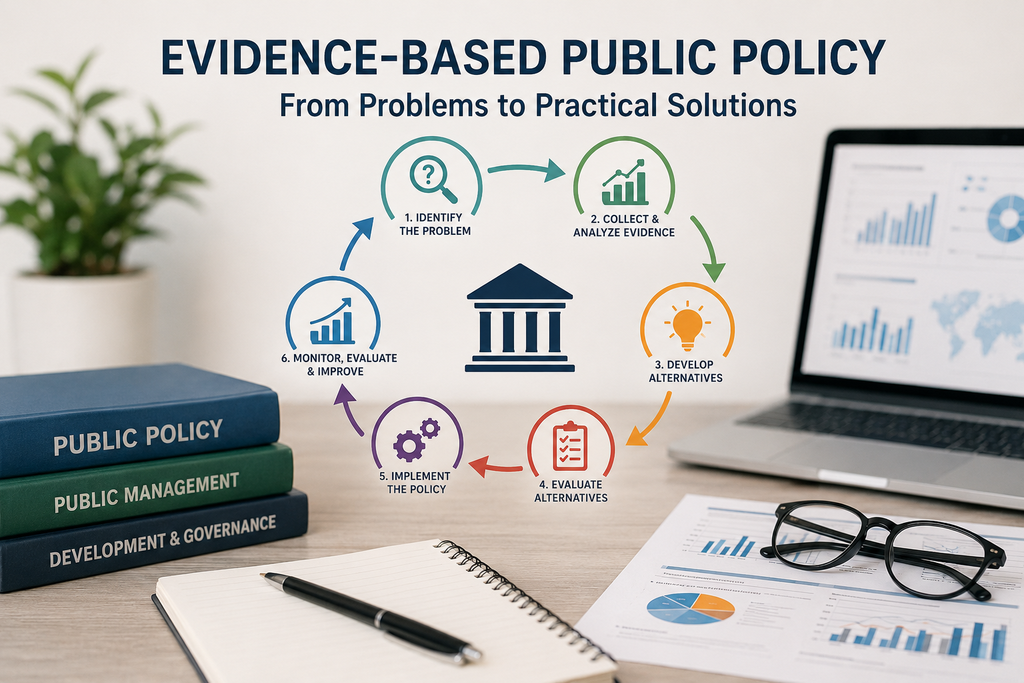
A useful policy-development process can be divided into several stages. Although different policy frameworks may use different terminology, the fundamental process generally involves identifying the problem, gathering evidence, developing alternatives, evaluating those alternatives, implementing the selected policy, and assessing its results.
1. Identify and Define the Problem
The first step in policy analysis is to clearly understand and define the public problem.
A poorly defined problem can lead to an ineffective solution. For example, describing a situation simply as “unemployment” may not be sufficient.
A policy analyst should ask:
- Who is affected?
- Where is the problem concentrated?
- What are its underlying causes?
- How has it changed over time?
- Which groups are most vulnerable?
- What existing policies are already addressing it?
Good policy begins with good problem definition.
Problem definition is particularly important because the way a problem is defined can influence the solutions that policymakers consider. If unemployment is viewed primarily as a lack of skills, policymakers may prioritize vocational training. If it is viewed as a lack of economic opportunities, policymakers may focus more heavily on private-sector development and investment.
Therefore, defining the problem requires careful examination of its underlying causes rather than simply describing its symptoms.
2. Collect and Analyze Evidence
Policy decisions should be informed by credible evidence.
Evidence can come from:
- Government statistics
- Household surveys
- Administrative data
- Academic research
- Interviews
- Focus groups
- Program evaluations
- International comparisons
Quantitative data can show the scale and distribution of a problem, while qualitative research can help explain people’s experiences and the reasons behind observed outcomes.
For example, statistical data may show that unemployment is higher in rural areas, while interviews with rural communities may reveal that limited transportation, lack of financial services, insufficient skills, or weak market access are contributing to the problem.
The strongest policy analysis often combines quantitative and qualitative evidence.
3. Develop Policy Alternatives
There is rarely only one possible solution to a public problem.
A policy analyst should develop several alternatives and examine their advantages and disadvantages.
For example, to increase women’s economic participation, possible interventions might include:
- Skills-development programs
- Access to financial services
- Cash-transfer programs
- Support for women-owned businesses
- Childcare assistance
- Legal and institutional reforms
Each alternative should be assessed according to factors such as cost, effectiveness, political feasibility, administrative capacity, equity, and potential social impact.
Considering multiple alternatives allows policymakers to compare different approaches rather than automatically adopting the first proposed solution.
4. Evaluate the Policy Alternatives
A policy alternative may look attractive but still be impractical.
Policy evaluation should consider several important questions.
Effectiveness:
Will the policy achieve its intended objective?
Efficiency:
Can the objective be achieved using resources efficiently?
Equity:
Who benefits from the policy, and who might be excluded?
Feasibility:
Can government institutions realistically implement the policy?
Sustainability:
Can the program continue over the long term?
Unintended consequences:
Could the intervention create new problems?
This multidimensional analysis helps policymakers move beyond political slogans and toward practical solutions.
The Importance of Data in Public Management
Modern public management increasingly depends on data.
Government agencies collect enormous amounts of information, but data alone does not automatically produce better decisions. Institutions need the capacity to transform data into useful knowledge.
For example, a government may know how many people receive a social assistance program. But policymakers may also need to know:
- Are the intended beneficiaries actually receiving assistance?
- Has the program reduced poverty?
- Are resources reaching rural communities?
- Is the program cost-effective?
- Are there groups being unintentionally excluded?
These questions demonstrate why data should not simply be collected. It should be analyzed and used to improve decision-making.
Using Data for Better Decisions
Data can help policymakers understand the scale of a problem, identify vulnerable populations, allocate resources, monitor performance, and evaluate whether government programs are achieving their objectives.
However, policymakers must also consider the quality and reliability of the data.
Poor-quality or incomplete information can lead to poor decisions. Therefore, public institutions need systems that support accurate data collection, analysis, reporting, and interpretation.
Monitoring and Evaluation
Monitoring and evaluation should be integrated into policy design rather than added after implementation.
Monitoring helps policymakers understand whether activities are being implemented according to plan.
Evaluation goes further by examining whether those activities are actually producing the intended outcomes.
For example, a government may establish a training program for unemployed young people. Monitoring may show how many people attended the training. Evaluation should ask a deeper question:
Did participants actually obtain employment as a result of the program?
This distinction between activities, outputs, outcomes, and broader impacts is fundamental to effective public management.
Policy Implementation: The Often-Forgotten Challenge
Designing a good policy is only half the job.
Many policies fail not because the underlying idea is necessarily wrong, but because implementation is weak.
A well-designed policy may encounter significant difficulties when it reaches the implementation stage.
Common Challenges in Policy Implementation
Implementation may be affected by:
- Limited institutional capacity
- Insufficient funding
- Weak coordination
- Lack of trained personnel
- Corruption
- Political interference
- Poor communication
- Inadequate monitoring
- Resistance to organizational change
These challenges demonstrate that policy design and policy implementation cannot be treated as completely separate processes.
A policy should be designed with the actual institutional environment in mind.
Connecting Policy Design With Implementation
Public managers must think about implementation from the beginning.
A policy document should answer not only what should be done, but also:
- Who will implement it?
- How will it be financed?
- What institutions will be responsible?
- What resources will be required?
- When will implementation occur?
- What risks could affect implementation?
- How will success be measured?
The difference between a policy that exists on paper and a policy that produces real results often depends on implementation capacity.
The Role of Public Managers
Public managers occupy a critical position between policy formulation and policy implementation.
They must translate broad political objectives into operational programs and ensure that public institutions have the capacity to deliver those programs effectively.
An effective public manager needs more than administrative skills. Public managers also need the ability to:
- Analyze complex problems
- Manage organizations
- Allocate scarce resources
- Coordinate stakeholders
- Interpret evidence
- Communicate effectively
- Monitor performance
- Adapt to changing circumstances
Leadership and Decision-Making
Public managers frequently operate in environments where resources are limited and competing interests are present.
Strong leadership can help institutions establish priorities, coordinate employees, manage organizational change, and maintain accountability.
Good decision-making also requires an understanding of evidence, institutional constraints, stakeholder interests, and potential consequences.
Managing Public Resources
Public resources are limited, while public needs are often extensive.
Public managers therefore have a responsibility to ensure that financial, human, and institutional resources are used efficiently and responsibly.
Resource allocation should be connected to clearly defined objectives and measurable results.
Building Institutional Capacity
Even well-designed policies can fail when institutions lack the capacity to implement them.
Institutional capacity includes:
- Skilled personnel
- Effective leadership
- Clear organizational structures
- Adequate financial resources
- Reliable information systems
- Effective coordination
- Accountability mechanisms
Strengthening institutions is therefore an important component of sustainable public management.
Evidence-Based Policy in Developing Countries
Evidence-based policymaking is particularly important in developing countries because governments often operate under severe resource constraints.
When resources are limited, policymakers cannot afford to invest heavily in programs without understanding whether those programs are producing meaningful results.
Governments must therefore make difficult choices about which programs to prioritize and how resources can generate the greatest social benefit.
Resource Constraints
Limited budgets require governments to establish clear priorities.
A government may face competing demands for investment in education, healthcare, infrastructure, social protection, economic development, and other sectors.
Evidence-based analysis can help policymakers compare these priorities and determine where public resources may have the greatest impact.
Institutional Capacity
Developing countries may also face challenges related to institutional capacity.
Weak administrative systems, limited technical expertise, inadequate coordination, and insufficient monitoring mechanisms can reduce the effectiveness of public programs.
Strengthening institutional capacity should therefore be considered an important part of development policy.
Equity and Inclusion
Economic development should not be measured only by aggregate economic indicators.
Policymakers should also consider who benefits from development and whether vulnerable or marginalized communities have access to opportunities and public services.
Policies should therefore consider both efficiency and equity.
The Policy Cycle: From Evidence to Improvement
For evidence-based policymaking to become effective, governments should view policy development as a continuous process rather than a one-time decision.
A useful policy cycle can be represented as:
Evidence → Analysis → Policy Design → Implementation → Monitoring → Evaluation → Improvement
Each stage informs the next.
Evidence helps identify the problem. Analysis helps determine possible solutions. Policy design translates analysis into an intervention. Implementation puts the policy into practice. Monitoring tracks progress. Evaluation assesses results. The findings can then be used to improve the policy.
Why Policies Must Adapt
Societies and economic conditions change over time.
A policy that was appropriate five years ago may not produce the same results today.
For this reason, governments should be willing to learn from implementation and evaluation.
Policy adaptation does not necessarily mean that the original policy was a failure. Instead, it can demonstrate that institutions are capable of learning and responding to new evidence.
Policy Is About People
Although policy analysis involves statistics, economic models, institutional frameworks, and administrative systems, public policy ultimately concerns people.
A successful policy should improve people’s lives.
Therefore, policymakers should consider not only aggregate outcomes but also distributional effects.
For example, a program that increases average income may still fail to address inequality if the benefits are concentrated among a small segment of the population.
Effectiveness and Equity
An effective policy should achieve its intended objectives while also considering how benefits and costs are distributed across society.
This requires policymakers to ask:
- Who benefits?
- Who bears the costs?
- Who may be excluded?
- Are vulnerable groups adequately considered?
- Are resources reaching the communities that need them most?
These questions make equity and inclusion essential components of responsible public policy.
Putting Citizens at the Center of Policy
Public institutions exist to serve society.
Therefore, policymakers and public managers should consider citizens’ experiences when designing and evaluating public programs.
Consultation, participation, transparency, and accountability can help governments understand whether policies are addressing real needs.
A policy should ultimately be judged not only by the quality of its documents, but by the difference it makes in people’s lives.
Conclusion
Effective public management requires more than good intentions.
It requires institutions capable of identifying problems, analyzing evidence, designing realistic interventions, implementing programs effectively, monitoring performance, and learning from results.
Public policy should therefore be viewed as a continuous process of:
Problem Identification → Evidence Gathering → Analysis → Policy Design → Implementation → Monitoring → Evaluation → Improvement
The ultimate goal of public management is not simply to create policies or programs. It is to use public resources responsibly to produce measurable improvements in society.
In an increasingly complex world, governments need policymakers and public managers who can connect evidence with action.
The quality of public policy depends not only on the ideas behind it, but also on the evidence supporting those ideas, the institutions responsible for implementation, and the ability of governments to learn from experience.
Ultimately, effective public management is about turning public problems into practical solutions and public resources into meaningful results.
That connection between evidence, policy, management, and development is at the heart of effective public management and policy analysis.