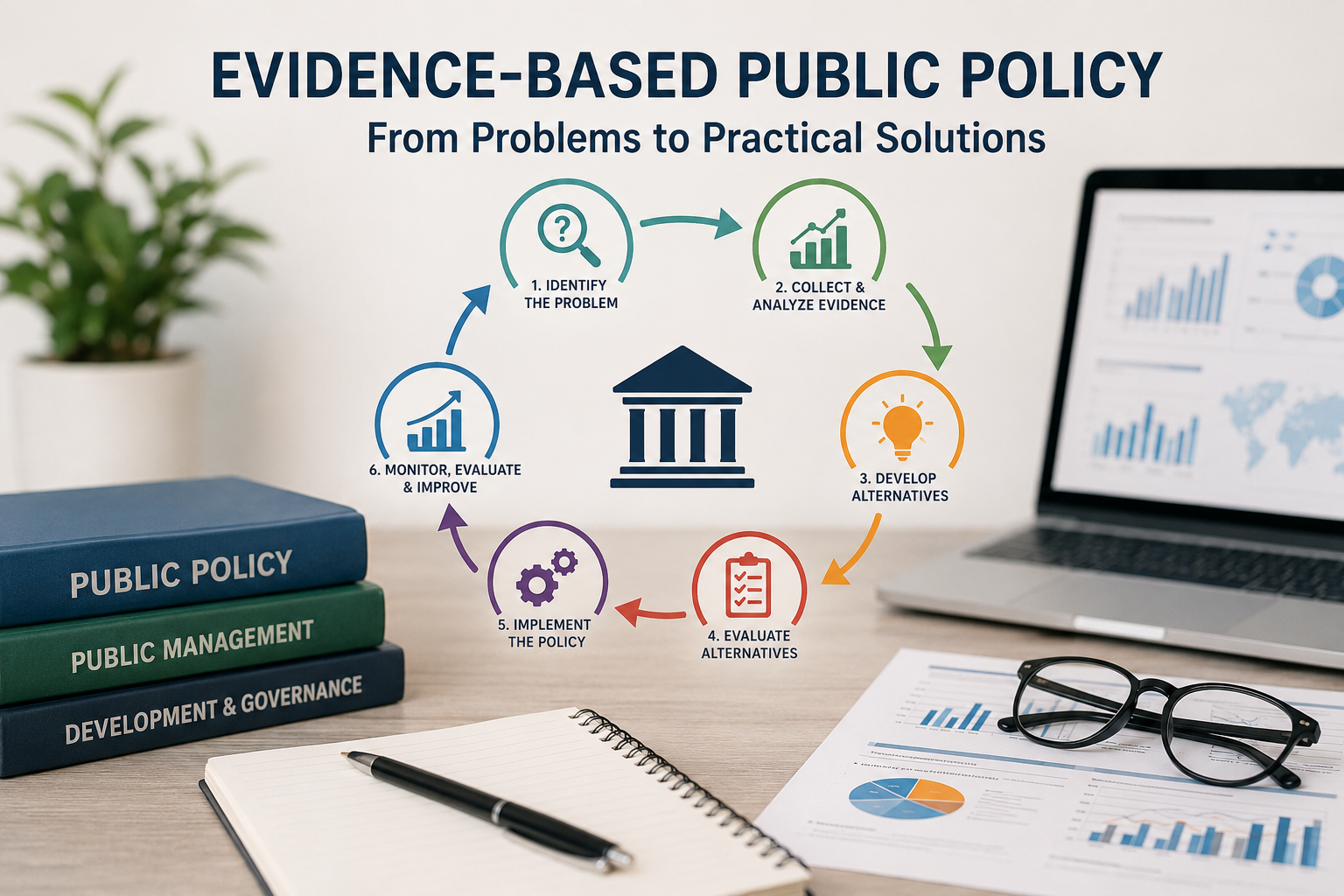
Evidence-Based Public Policy: From Problems to Practical Solutions
Introduction
Governments make decisions that affect almost every aspect of people’s lives—from education and healthcare to employment, economic development, security, and social protection. However, good intentions alone do not guarantee good public policy. Effective policies require careful analysis, reliable evidence, responsible management, and continuous evaluation.
Table of Contents
Public policy analysis
provides a systematic approach to understanding public problems, identifying possible solutions, and determining which interventions are most likely to produce meaningful results.In developing countries, where public resources are often limited and social needs are significant, evidence-based policymaking becomes particularly important.
Governments must make difficult choices about how to allocate limited financial, human, and institutional resources while attempting to achieve the greatest possible public benefit.
Evidence-based policymaking can help governments move away from decisions based primarily on assumptions, political pressure, or short-term considerations and toward decisions informed by reliable information and systematic analysis
What Is Public Policy?
Public policy can be understood as a set of decisions, actions, strategies, and priorities adopted by governments to address problems affecting society.
Public policies can address a wide range of issues, including:
- Poverty and unemployment
- Access to education
- Healthcare services
- Women’s economic participation
- Infrastructure development
- Environmental protection
- Public-sector reform
- Social protection
- Economic growth
A successful policy should not simply identify a problem. It should provide a realistic pathway toward addressing that problem.
- abc
- def
From Public Problems to Policy Solutions
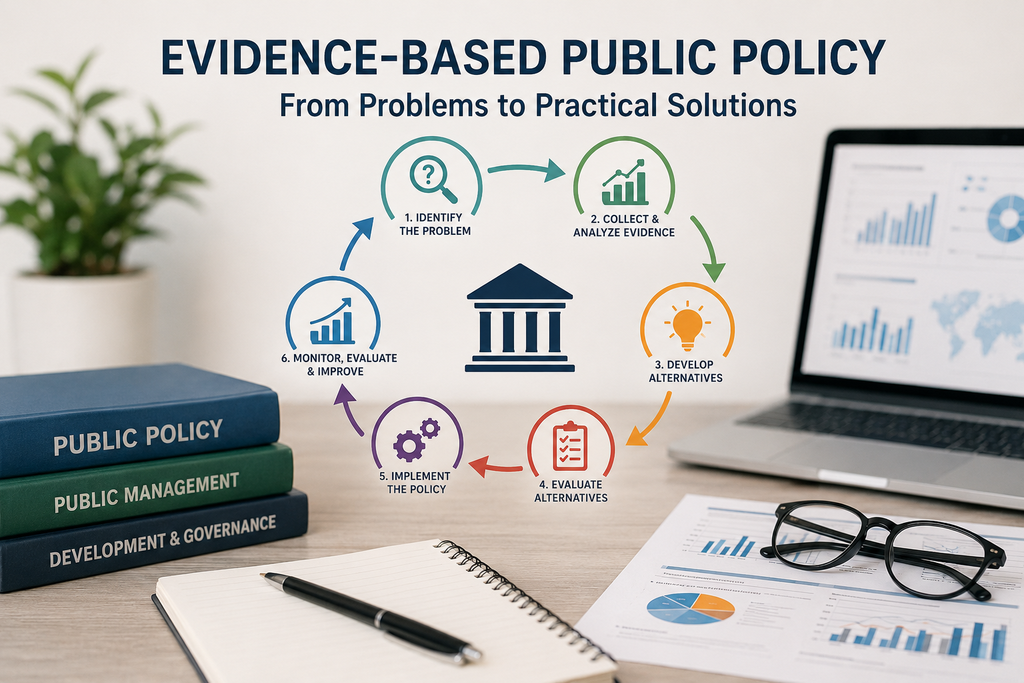
A useful policy-development process can be divided into several stages. Although different policy frameworks may use different terminology, the fundamental process generally involves identifying the problem, gathering evidence, developing alternatives, evaluating those alternatives, implementing the selected policy, and assessing its results.
1. Identify and Define the Problem
The first step in policy analysis is to clearly understand and define the public problem.
A poorly defined problem can lead to an ineffective solution. For example, describing a situation simply as “unemployment” may not be sufficient.
A policy analyst should ask:
- Who is affected?
- Where is the problem concentrated?
- What are its underlying causes?
- How has it changed over time?
- Which groups are most vulnerable?
- What existing policies are already addressing it?
Good policy begins with good problem definition.
Problem definition is particularly important because the way a problem is defined can influence the solutions that policymakers consider. If unemployment is viewed primarily as a lack of skills, policymakers may prioritize vocational training. If it is viewed as a lack of economic opportunities, policymakers may focus more heavily on private-sector development and investment.
2. Collect and Analyze Evidence
Policy decisions should be informed by credible evidence.
Evidence can come from:
- Government statistics
- Household surveys
- Administrative data
- Academic research
- Interviews
- Focus groups
- Program evaluations
- International comparisons
Conclusion
Effective public management requires more than good intentions.
It requires institutions capable of identifying problems, analyzing evidence, designing realistic interventions, implementing programs effectively, monitoring performance, and learning from results.
Public policy should therefore be viewed as a continuous process of:
Problem Identification → Evidence Gathering → Analysis → Policy Design → Implementation → Monitoring → Evaluation → Improvement
The ultimate goal of public management is not simply to create policies or programs. It is to use public resources responsibly to produce measurable improvements in society.
In an increasingly complex world, governments need policymakers and public managers who can connect evidence with action.
The quality of public policy depends not only on the ideas behind it, but also on the evidence supporting those ideas, the institutions responsible for implementation, and the ability of governments to learn from experience.